Dear friends,

For Christmas and the new year, which is always an opportunity, one of many,

to wish, intend, pray,

for peace.

Let us train our minds to be a void,

Free and stable enough to recognize

Aggression and hatred (both inward and outward) -

In order not to turn aggressive and hateful.

May in the coming year,

We will be more in touch with our compassion,

For loving more and healing more pains.

With much love to you all,


Hamed, Erella, Ehud, Dany, Assaf,

and all the other members of the “Villages Group”

Friday. The day of the first candle of Hanukah Jewish feast. We are on the way to Salem village with Carin (an Australian young woman who helps us to develop the music project there). It is nice to go there on the day of the first candle. Visiting our friends and developing the next step of the children music center there, feels like lighting a candle.

It is just that on the way we’ve planned to visit another friend in Yasouf village, and buy some olive oil from him. Just before entering his village he called us on phone to tell us not to come because some settlers had “lit a Hanuka candle” their way by burning the Mosque of the village. Just two different ways to light a candle.

Not much of a joy accompanied us along the rest of the day. The only strength we’ve felt was the strength of the unconditional friendship between ourselves and with our Palestinian friends.

Here is a video about the music center, prepared by Natti Adler:

Here is Carin’s description of the visit as posted on her “Looking for Shalom” blog:

You know what? I am exhausted. It feels like I never stop. My journeys into the West Bank are long and tiring. But what can I say? I am addicted. And today was a particularly special day. I would not have missed it for the world. I went to a place where I personally feel part of the peace efforts, and where many of you are personally part of the peace efforts.

I went to Salem, a Palestinian village in the northern part of the West Bank, around 2km from the major city of Nablus. I joined two kibbutzniks, Erella and Ehud, from the Villages Group for their weekly family visits. The main reason we went to Salem was to visit Jubier Ishtayya, a local musician and teacher who is starting a music centre with your help.

Erella met Jubier a few years ago. They connected over a common dream to create peace through music. Well, peace is actually the word I chose. Erella and Jubier are more grounded than that. They do not have any grandiose ideas about peace. Instead, they believe in the transformative power of music. They believe that music is a tool for developing creative minds, rather than destructive ones. The music centre will be a place of learning, artistic expression and concerts; a centre for healing and hope.

I met Ehud, Erella and Jubier earlier this year and I was blown away. Not by the idea of the project, that was not new to me, but by the spirit, the energy and the relationship between these three people. Their idea was well thought out, realistic, and targeted at a particularly vulnerable group: boys and girls in their late teens, living in extreme conditions, with few employment opportunities, and nothing to do in the afternoons. The centre will start small, but they have big plans for the future.

And the dream was made possible because of support from many of you. So tonight, even YOU can put smiles on your faces. The music center will open in January, half the students will be girls and half boys. The head of the village has provided the space and political support for the project.

It is wonderful to feel part of a concrete project on the ground; particularly one that I so strongly believe in. This gives me hope. And I promise, before I finish this journey, I will provide you with plenty more ideas for how you can stay engaged.

20 days to go…
Images of the Salem Music Center can be found here.

Dear friends,
We, Erella Dunayevsky and Hamed Qawasme as representatives of the “Villages Group”, traveled across Britain for 15 days during the second half of November. The main aim was to visit people who visited Hebron and South Hebron hills and came to know us, as well as widening our connections’ web with new people. Another aim was to do some fund raising for specific needs which exist constantly in the area.
In London we met with people from Moshe House; Jews For Justice For Palestinians; and New Israel Fund and Mr. Harrison.
In Bristol - with the Easton Cowboys.
In Exeter with Mr. Tony Davis and friends.
In Cambridge – with Lawyers Without Borders, Amnesty International and students in Cambridge University.
In Leeds – with people from Together For Peace.
In Hexham – with the Quakers community.
In Edinburgh – with Scottish Palestinian Forum (S.P.F.) and the Quakers.
In Glasgow - with the West of Scotland Group of  S.P.F and Jews For Just Peace.
In Durham - with Palestinian Solidarity Campaign.
In Forfar – with the Quakers community.
The meetings were inspiring. We met with people who deeply and maturely care for human rights and human dignity. We gained a lot of strength from them all along the intensive journey.
The meetings started with an hour presentation made by both Erella and Hamed presenting the facts and numbers of the humanitarian dignity crises in the West Bank, and zooming into some of the stories which stand behind it.
Immediately after returning we’ve realized that the journey has not ended, that there is something in the encounter point with the people which is still echoing within our hearts and invites us to develop some structure which will enable it to continue – supporting the spirit as well as the financial needs resulting from the Villages Group activities in South Hebron Hills.
We, in the Villages Group, in addition to our ongoing presence in the communities of the area, see ourselves as a bridge between the local Palestinians in this peripheral remote  area and the outer world.
Therefore we invite you to think with us (through emails) what might be the efficient and effective structure to be built between us that will enable ongoing support utilizing the momentum of the tour.
The addresses are:
Hamed Qawasme:  qawahame20@yahoo.com Erella Dunayevsky: danidun@shoval.org.il Ehud Krinis: ksehud@gmail.com
Today while visiting Umm al-kheir, one of the elders told us:  “when you come to visit you bring us a bit from the smell of freedom”.
We thank you all again for supporting us in this tour to sustain and strengthen the above.
Yours, with much love, Hamed and Erella.

One of the most significant developments in south Hebron, which happened few weeks ago, is the rehabilitation of Bir al-’Id – once the biggest cave dwellers community in the area, and in recent years, an abandoned place (forcibly evacuated exactly 10 years ago under the Barak government), completely deserted under the pressures of the occupation forces and (especially) the nearby settlers post.

The battle for the rehabilitation of Bir al-’Id has moved
now from the court back to the ground. It is an everyday battle, consuming tremendous efforts from the local Palestinian returnees and the Israeli and International volunteers who try to help them. Below is the story of Bir al-’Id which was told by one of the returnees – Mahdi – and recorded by Ta’ayush activist and world-renowned scholar David Shulman.

—————–

November 21, 2009 Bi’r al-’Id

“It’s because of the truth that we go there,” Amiel says to me before we get into the waiting “transit” van. He’s been thinking about it since last week’s lectures in celebration of Nita’s book on making peace. I’d been trying to explain in my talk why I keep going down to the South Hebron hills when, after all, our impact on the situation there is so minimal, so pointillist, the task so Sisyphean, the sense of futility so overwhelming. I claimed that despite all this, there is something good about being there, in those landscapes and with those people, and that it had something to do with the difference between truth and falsehood. There are, it seems, situations when the distinction is truly palpable. I listen to my prime minister, Mr. Netanyahu, say that he hopes the Palestinians “will get their act together, so that negotiations can begin.”

You hear the lie at once, and you can’t help noticing how thin and superficial it is, how lacking in any human depth; also, of course, how astonishingly twisted and corrupt. We live in the midst of swirling clouds of lies. “That’s the thing about South Hebron,” Amiel says. “It exposes the lie and reveals the truth in all its clarity. That is why we go there.” “Truth” sounds, at first, like a hard and heavy word, and to say “the truth,” as if there were only one and not many, only adds to the heaviness, but I can tell you that there are moments when truth is light and luminous and singular and rather simple and when it lightens the heart to see and taste it.

Like today. We start off southward in the van, but within ten minutes the police appear from nowhere and pull us over. It’s clear they know where we’re going, and why, and they must have received an order from someone higher up to harass us as best they can, so they pick on the most vulnerable among us, our Palestinian driver, Zaidan, from Beit Hanina in the north of the city. They pull him from the van into the police car, and they have rather a lot of questions to ask him about his driver’s license, his insurance, how many people he is allowed to drive in the van, whether he is being paid for this or not, and so on. They hunt through the booklet of rules and laws and, sure enough, they eventually hit on some regulation that allows them to book a charge and slap a fine of 500 shekels on Zaidan—it seems he had 12 passengers in the van but his license allows him to drive only 10. There are endless forms to fill out while we wait helplessly in the mid-morning sun and one of the two policemen swaggers back and forth scowling at us and barking threats. After an hour or so they issue a temporary license which allows Zaidan to drive for the next twenty-four hours, long enough, as it happens, to get us down to south Hebron.

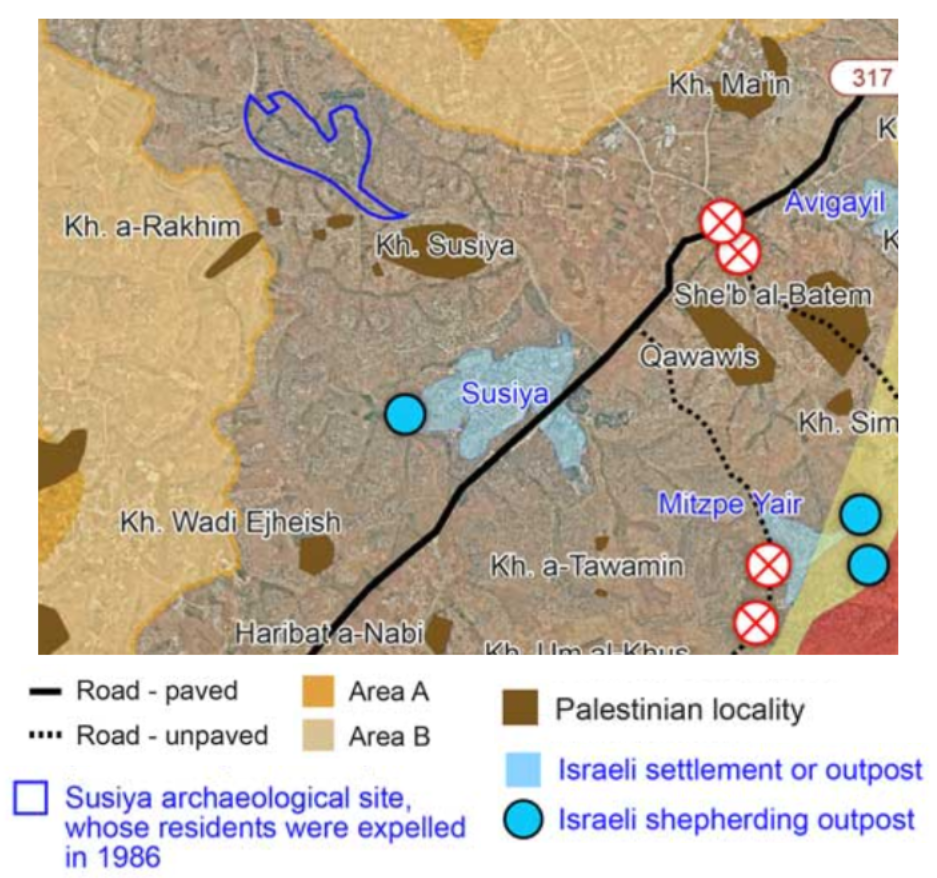
We’re on our way to Bi’r al-’Id, but first we stop at Mufaqara—a smattering of black tents on grey rock– to escort the shepherds for a while, since already this morning settlers from the “illegal outpost” of Avigail have tried to drive them off their grazing grounds, as happens regularly. It’s a brilliant winter day, the air cool as fine crystal; from this point high in the hills, you can see almost to the end of the earth, each tiny trace of stone or thorn or goat-dung limned in the burning light, the hills rising and falling and eddying, awash in brown and blue and gold. The goats are happily chewing fresh winter thorns, and for the moment, at least, the settlers have retired into their ugly caravans. The moment doesn’t last very long; no sooner do we take our leave, most of us, than a mad settler dashes into the Palestinian encampment shouting curses, and Michael, who has stayed behind for just such an emergency, confronts him, and there’s a scuffle and Michael is hurt a little before the soldiers arrive.

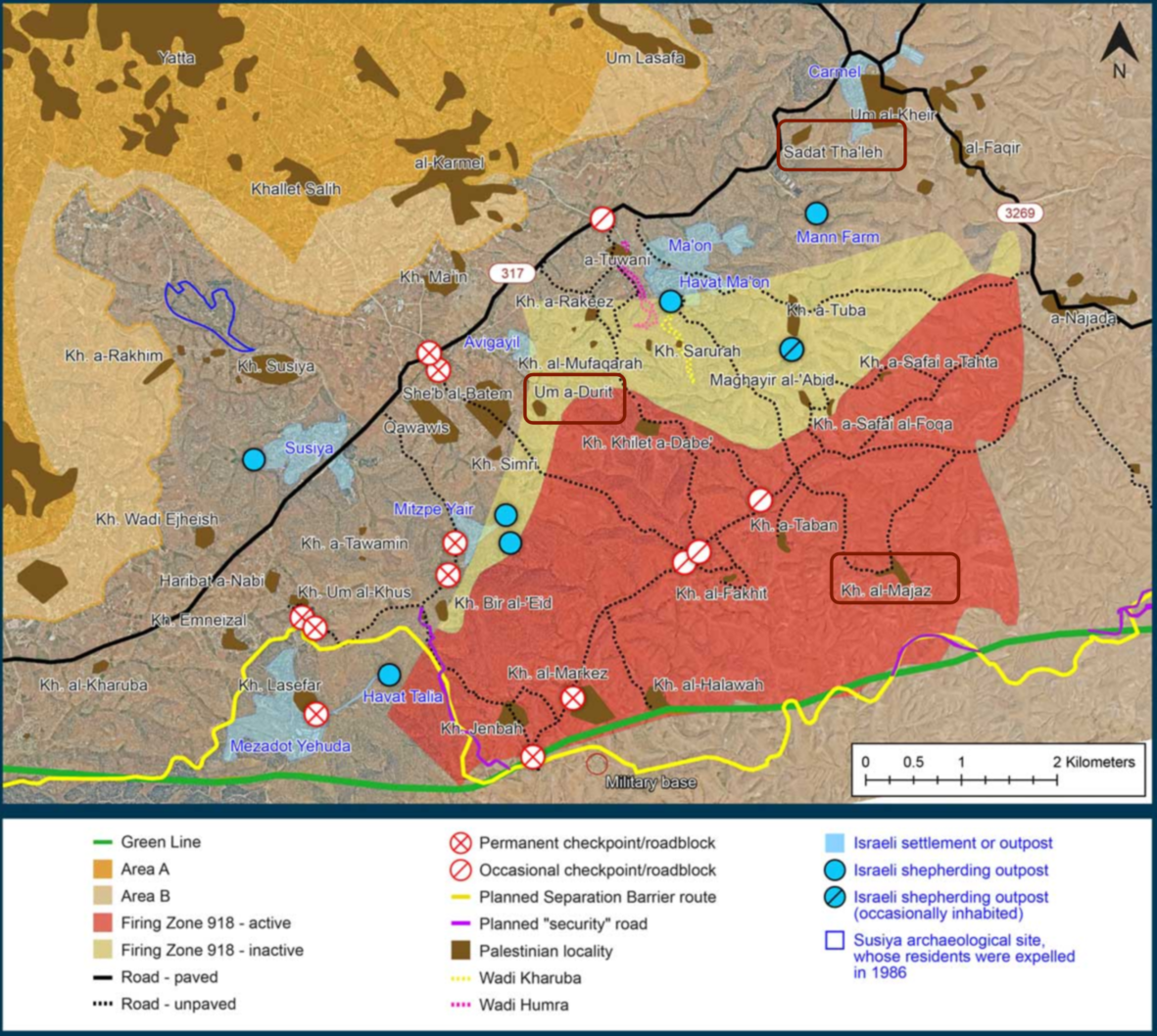
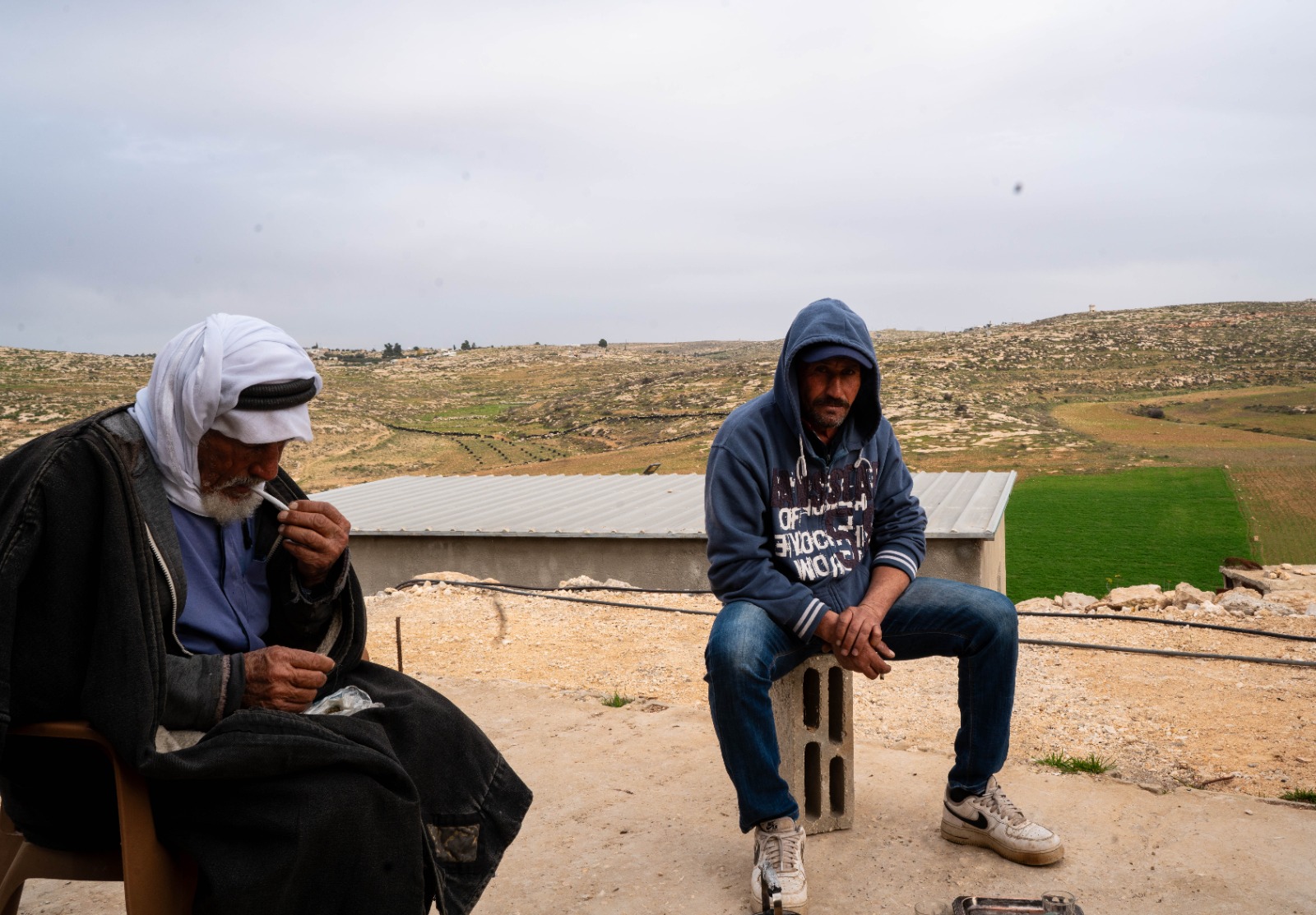
By then we have made our way on foot through the glowing desert, over the hills, to the tiny set of stone terraces and fences and goat-pens and caves that is called Bi’r al-’Id. It seems to grow organically out of the hillside, a slight extension of the escarpment and utterly at home in it, unlike the khaki-and-grey pre-fab houses of the Israeli settlement, another “illegal outpost,” of Mitzpeh Yair that peers down at Bi’r al-’Id from the top of the hill. There’s not much left of the caves; the army destroyed them, filling them with sand and rocks, in 1999. Originally some 400 people lived here. Two Palestinian families have now returned after a long struggle in the courts. Mahdi, whom I remember from a visit long ago, tells me the story in the thick, succulent Arabic of these shepherds, his wind-wrinkled face and black eyes alive with insult and rage.

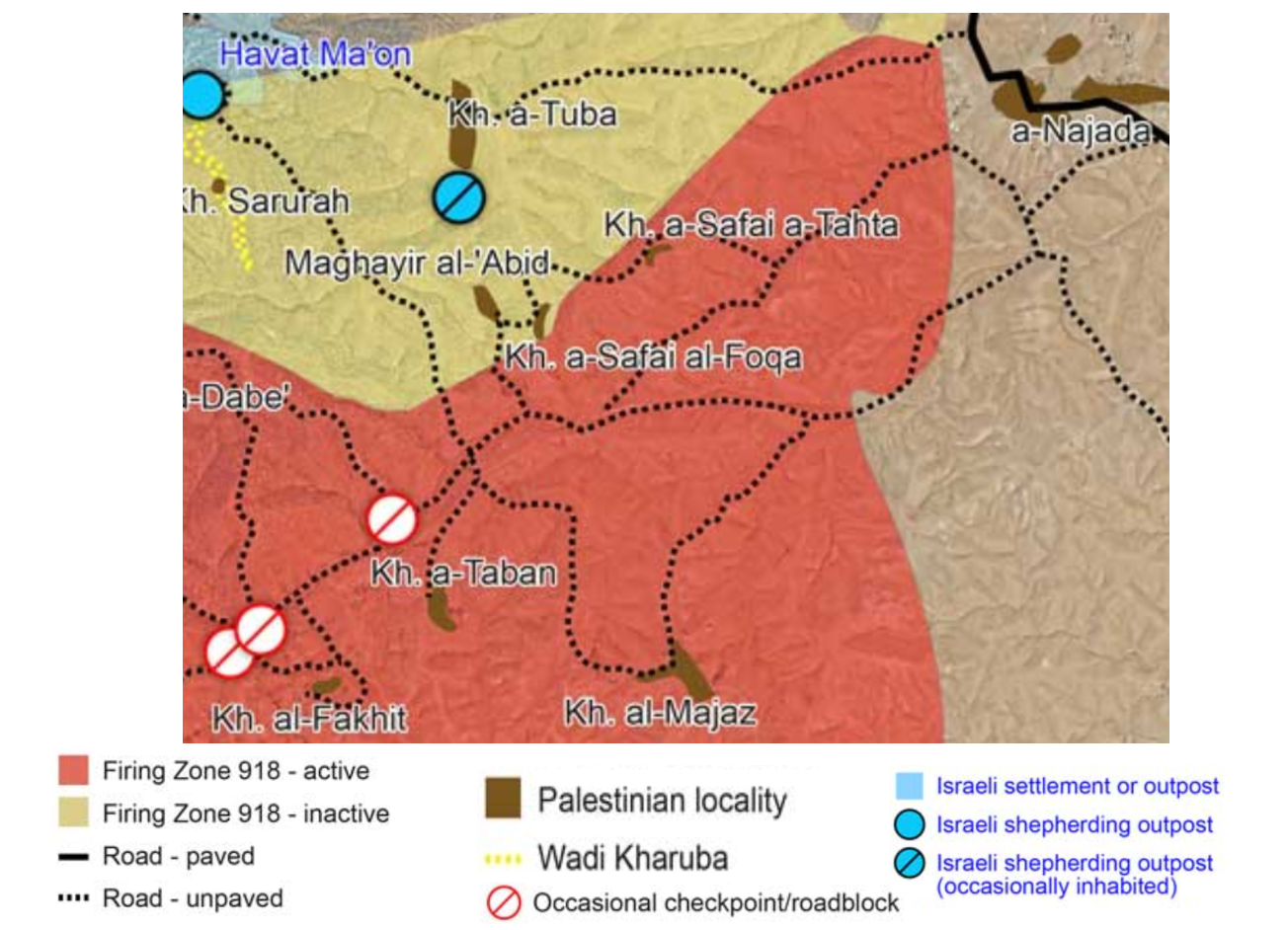
“First they drove us all away. It was November, 1999. Not just from Bi’r al-’Id but from all the villages here—Jinba, al-Halawi, Markaz, al-Taban, al-Faqit, Swaia foqa and Swaia tihta, al-Majaz, Murgh al-’Abid, Sa’aba, and Tuba. In March 2000 we came back for a little while, but the settlers attacked us over and over and then they drove us out again and we couldn’t return. They told the courts they wanted to use this area as a firing range for the army, and the courts let them do it. All these years we waited to come back, and we fought in the court, and two weeks ago the court said we could go home. The Rabbis for Human Rights were here, Rabbi Asherman came and helped us rebuild. The settlers attack us regularly, every day, they throw rocks at us and drive away the herds; last week they killed a baby lamb. Now the court says we can live here, but the army has closed the road and they tell us we cannot use it, so there is nowhere we can go, and we cannot bring what we need to build. There is a woman here who is seven months pregnant; how will she get to the hospital? My family had two thousand dunams of land, all the way down to Jinba; the settlers and the soldiers have stolen everything but fifty dunams; that is all that is left.”


(pictures taken from a November 15th photo-essay about the return, by Francesca+MC on Indybay.org)

Mahdi points, despairing, toward the tents of Jinba, far below us in the desert. It is high noon. Settlers to our left, at Mitzpeh Yair; settlers to our right in yet another “illegal outpost,” this one appropriately called Lucifer’s Farm. An immense, oddly orderly line of sheep, following the shepherds from Jinba, is spread along the whole length of the next mountain ridge, white on golden brown. You can easily see across the border into Jordan and the purple hills of Moab. I think to myself: this must be the most beautiful spot in the Middle East. A place to come home to: I am moved, seeing the terraces re-emerging from the hill. And in the strangely delicious silence of these open spaces, I am listening, wholly attentive, to the unmistakable resonance of truth.

And to the equally unmistakable echo of the lie: the army, compelled by the Supreme Court, has grudgingly allowed these people to come home, but it has cut off their only road to the outside world, no doubt “for security reasons.” They can be here, for now, but they can’t move in any direction. I don’t think we have to imagine the real reasons. Neither do we intend to accept the army’s writ. There is a tractor on its way to Bi’r al-’Id with canvas for tents and sacks of cement. We’re going to see that it arrives.

So we head back to the main road, past the gate of Mitzpeh Yair. Army jeeps pass us from time to time without stopping. I’m feeling light—the truth effect, perhaps—and almost drunk on air and color and friendship. We laugh as we walk. Someone says he’s heard that a group of gay religious Israeli men want to establish a settlement around here. Seems appropriate, I say, everything is so wild here anyway, I only wonder which side they’ll choose to be on—that of the orthodox Jewish settlers or the Palestinians? It’s far from clear, like most things. We speak of the Goldstone report on Gaza and of Abu Mazen’s call, this week, for a third, popular Intifada, a non-violent one, like at Bil’in and Na’alin. For years we’ve been saying that a Palestinian campaign of Gandhian-style civil disobedience is the one thing that could bring the occupation to an end. Israel has no answer to hundreds of thousands of Palestinians marching in non-violent resistance in the territories; if this happens, and the Palestinians declare their state, as I hope and believe they will, the Israeli peace groups—what’s left of them—will be marching beside them. Perhaps the Israeli peace camp will rise from the ashes. Happy early-afternoon thoughts: the tender, scary tang of hope.

And then, suddenly, in the distance, we see the tractor. We race down the road. Ismail ‘Aradeh is driving it, with an attached wagon full of heavy sacks of cement and grout, various poles and rolls of canvas and, crushed against the wire at the far end, one large goat and a small kid. By the time we reach him, Ismail has, of course, been stopped by the soldiers: some seven or eight of them in two jeeps have blocked the road. We protest. They phone their headquarters, or some such authority; they are, they say, “checking” to see whether the tractor can or cannot pass.

We let them know what we think about their blockade; they can see we’re not about to leave. Meanwhile, Ismail is worried about his goats. He summons me to help him; we push and shove at the closest layer of cement sacks, clearing a little space; then he opens the back of the wagon and, before I know it, a rather heavy, furry, bleating goat is in my arms. It seems to approve of its new situation; air is more plentiful now, I guess, enveloped as I am by strong goat odors. We stare curiously at one another, Goat and I, perhaps both of us wondering what the future holds in store. Ezra, however, turns up just in time to extract the scrawny white kid from the wagon, and soon both Goat and the baby are ensconced in Ezra’s car and on their way over the hills to Bi’r al-’Id. I turn back to the soldiers; Assaf signals to me, thumbs up: they’ve been ordered to open the road. The tractor starts chugging slowly uphill. It would never have happened if we hadn’t been here today.

An hour later there’s another tractor, and the soldiers are there to stop it but it’s too late now, and soon our vehicles are going back and forth to Bi’r al-’Id carrying more volunteers and materials. Will they close the road again as soon as we’re gone? Maybe. The settlers will certainly pressure the army to do so. If they close it again, we’ll come back and re-open it. But it may be harder for them now that we’ve established the principle. “That’s how it works,” Yehuda explains to one of the international volunteers. “Our task is to push the limits. Always a little further. We push and we prod and we test and the system tries to holds us down, but often we manage to shake them up and extend the range of what is possible. Maybe only a little, but each time we win, it makes a difference.” Even Sisyphus has his hopeful moments.

Look how simple things can be. It’s as if all the violent mendacity of the settlers and the soldiers and the border police who protect them and the prime minister and the minister of defense and their dark allies has evaporated in the intense limpid radiance of this winter afternoon. To keep the families of Bi’r al-’Id from their simple homes is to cleave to all that is false in the human world—to embrace the lie. Either you help them to bring their lambs and goats back to the stone pens waiting for them on this hill, or you stand in their way and hurt them. It’s your choice. Standing on the sidelines and watching passively is a lot like blocking the road. Either you help them unload the bags of cement and start rebuilding the broken terraces, or you take your stand with the system that drove them out in the first place and now continues to threaten them every day, as Mahdi says. From out of the lunacy and inherent murkiness of the world we live in, you get a sudden shaft of light: a tractor, a shepherd, a goat, a cave that is home again, a truth.

In the middle of last week – Wednesday Nov. 12 – the soldiers from the occupation civil administration appeared again in the two Umm al-Kheir clusters, next to the settlement of Carmel in south Mt. Hebron. In their old tradition of “civil service”, they distributed 11 orders of halting constructing work – the legalistic act which precedes house demolition.

As the people of those two clusters of Umm al-Kheir, don’t have much of construction work left – most of their constructed houses were demolished in the many rounds of house demolition that were inflicted on them by the civil administration (see also here the 2007 demolition, in which Ezra Nawi was charged while trying to stop it)– the current halt-construction orders were addressed mostly to tents (donation of the Red Cross form the last round of demolitions), tin shacks, an outhouse and a toilet hole, along with three built houses located in the farthest spot form the settlement.

This indiscriminate mode of operation reveals the real end of the civil administration acts – to make the life of the local residents (who had lived there for 30 years before the establishment of the Israeli settlement in the 1980’s) so unbearable, so they would leave there dwellings out of their “free will”.

Ehud Krinis

Dear Friends and Supporters,

The generous donations of Jews, Muslims and Christians alike, made possible the opening of a second class of the Umm al-Kheir Learning Enrichment Program. The cluster where this class has now opened is the place that our friend and colleague Ezra Nawi tried to protest against a houses demolition – an incident that led to his recent conviction in an Israeli court.

In a place where not only every house that was built in the last 40 years have been demolished, but also the digging of the toilets under the ground is prevented by the occupation forces, the conditions in class (which is actually the tiny living room of the teacher Targhrid) are harsh, but as you can learn from the photos attached, the children’s spirits are high.


Ehud Krinis

Dear Friends and Supporters,

We in the Villages Group get much satisfaction in enabling others develop their own initiative through us. For the last two years we served as the mother organization and the close partners of the COMET-ME team, and their renewable energy project. This incubation term is now over. COMET-ME team will continue to develop the energy project with us by their side, but from the organizational point of view, they are by now completely independent, with their own NGO status.
While The COMET-ME energy project already won much publicity and success, another very important project, is now emerging and getting its stature, which we in the Villages Group served at the time as mother (in a more practical than organizational manner). This is the 2NEIGHBORS initiative which promises to bring livelihood to women in the caves dwellers area in south Mt. Hebron and elsewhere in the Occupied Territories, and to encourage cooperation between Palestinians and Israelis. I urge you to visit the 2NEIGHBORS website and think of ways each one of you can contribute to the success of this initiative.
Yours,

Ehud Krinis
Villages Group

BBC CHALLENGE E-MAIL TEXT FOR COMET-ME Comet-ME Needs YOUR Vote – Today! Comet-ME proudly announces it is one of 12 finalists in the BBC World Challenge 2009. This global competition focuses on grassroots projects and small businesses worldwide that are taking effective, innovative action in environmental and socio-economic issues. In November, the winning project receives an award of $20,000! Comet-ME would use this prize to expand our project and to provide sustainable energy to another community. The winning project will be determined by online voting between 28 September 2009 and 13 November 2009, at http://www.theworldchallenge.co.uk/index.php

Comet-ME, a group of Israelis, Palestinians, and international volunteers, works closely with very poor communities in the occupied areas of Palestine. Under Israeli military occupation for 42 years, these people have no access (for political reasons) to the electricity grid. Our common goal is to help these people build sustainable energy systems using solar and wind power. Illumination, communication, and refrigeration increase their potential for generating revenue and reducing chronic poverty. We work with mutual interest and mutual respect, in the conviction that what we build together can begin to heal what has been destroyed. Each community owns its own project, and its local committee makes all relevant decisions; we provide materials and knowledge for building the energy systems. We foster proactivity in these weak communities: teaching and encouraging them to maintain their energy systems leads them toward economic empowerment. All of us believe that working together on such projects weakens the barriers of suspicion and hostility, ultimately facilitating the end of racism and segregation in the Middle East. Building energy systems in the occupied territories, we face daily danger to our work, both from Israeli settlers and from the Israeli army. It’s critical, therefore, that we become internationally recognized. International public opinion has significant impact in Israel. For this reason, we ask you to cast your vote for Comet-ME in the BBC World Challenge 2009. Please visit the website noted above during the voting period of 28 September through 13 November 2009, and vote for Comet-ME. And then, please visit our website at http://www.comet-me.org/index.html to learn more about the work we are doing with communities in the South Hebron Hills of Palestine. We hope you will forward this e-mail to all your friends, encouraging them to join you in casting a vote for Comet-ME.

On Wednesday, September 9th, 2009, the Israeli army destroyed a trailer located on “Flag Hill”, several hundred meters west of Susiya settlement. A short while later, around 11:00, dozens of settlers showed up at the small living area of the Balal family in the Palestinian hamlet of Susiya. These settlers violently attacked the three family members who were present on the spot – the father, Abu Nimer; the mother, Umm Nimer, and their daughter Alia. They also burst into the family kitchen and broke everything they found. The assailants also cut the electric cable supplying solar energy to the family home. Soldiers arriving on the spot, shortly after the settlers, stood aside and did nothing to interfere until the mother of the family was hit on the head with a blunt object. Only then did the soldiers intervene and made the settlers leave the Balal family home. The same assailants proceeded towards the residence of the Shiniran family, but were blocked there by members of this large family who had been alerted in time. While the assault against the Balal family was going on, about ten other settlers attacked the family’s livestock and the son who herded the flock – Issa. Several members of other families came out to help him. A fight ensued between them and the settlers, which fortunately ended without casualties or detainees. The settlers also attacked a local photographer as he recorded the goings-on with a camera belonging to ‘B’tselem’ human rights organization, and broke his camera. All these actions took place as apart of what the settlers name ‘the price tag’ – a premeditated, regular procedure by which the settlers respond to any attempt on the part of the government and the army to carry out evacuation or dismantling of outposts, immediately assailing the Palestinian population living in close the vicinity. After collecting ‘price tags’, the same settlers-assailants resumed construction in the area of “Flag Hill” outpost (picture no. 1) and it seems this outpost will grow considerably in the very near future. Other attached photos show Umm Nimer, the mother of the family who has been attacked several times this year and this time was seriously beaten in her back and head (picture no. 2); the Balal family kitchen most of whose utensils were shattered (picture no. 3); and a general view of the attacked family’s living quarters (picture no. 4).

Ehud Krinis and Erella Dunayevsky The Villages Group
On the same evening the team of COMET-ME came and fixed the solar system

Dear Friends,
The last three months have been busy around here. Comet-ME was working on two issues in particular – fund raising and completing our work in Susya.
I will start with the good news: Comet-ME, using funds obtained from the German representative office in Ramallah and the Firedoll and Sparkplug foundations was able to complete the installation of solar home systems to all the families living in Susya. Most of July and the beginning of August were dedicated to the purchasing, construction and finally the installation of six more family solar systems in Susya and the upgrading of the community utility center we built in March. The installation itself was great. Very intense, and hot, but rewarding, with some of the families having to wait for their turn almost a year. The process took several days in which we worked with Susya maintenance team, the families and many of our friends (including a group from Engineers Without Borders – Israel).

On the left you can see the new system we installed with the Abu Malesh family whom we got to know while working on the installation of the utility center in March. The system there is a typical family system with three bulbs and an electricity socket to power a charger or radio. This time around we wired the electric cabinets ourselves, to reduce costs even further, and changed the operation voltage of the systems to 220V AC so as to allow the users the freedom from specialized DC equipment – they can now use regular light bulbs and appliances.
On the right you can see Noam trying to figure out which way is which with the turbine upgrade. The whole system is now more powerful then before and can power two refrigerators; a welcome addition two weeks before the Ramadan and the heat of the desert.

On the fund-raising front we had some success in the early summer when we were approved the three grants I mentioned above but, on the other hand, two substantial grant we were hoping to get now seem out of the question as the funding organizations themselves are under the burden of the economic crisis. We are now hard at work trying to develop new directions but it might take a while.
At this point you come into the picture – help us continue the work we do. Spread the word.

One more thing, last but most definitely not least. The BBC world challange is an annual competition for grass root organizations that bring social and environmental change. Comet-ME is very proud to be selected as one of the 12 finalists on the competition. The winner will be chosen by open internet voting that will start on the 28th of September. There is still some time to go but we will need each and every one of you to vote (for us, we hope) and get everybody you know to follow suit.

We have created a facebook account and a twitter account. Join us there so you can follow up on what we are up to and introduce us to your friends.

Yours,

Comet-ME

Comet-ME : Community Energy Technology in the Middle East
visit us at: http://www.comet-me.org/

Next Page »